
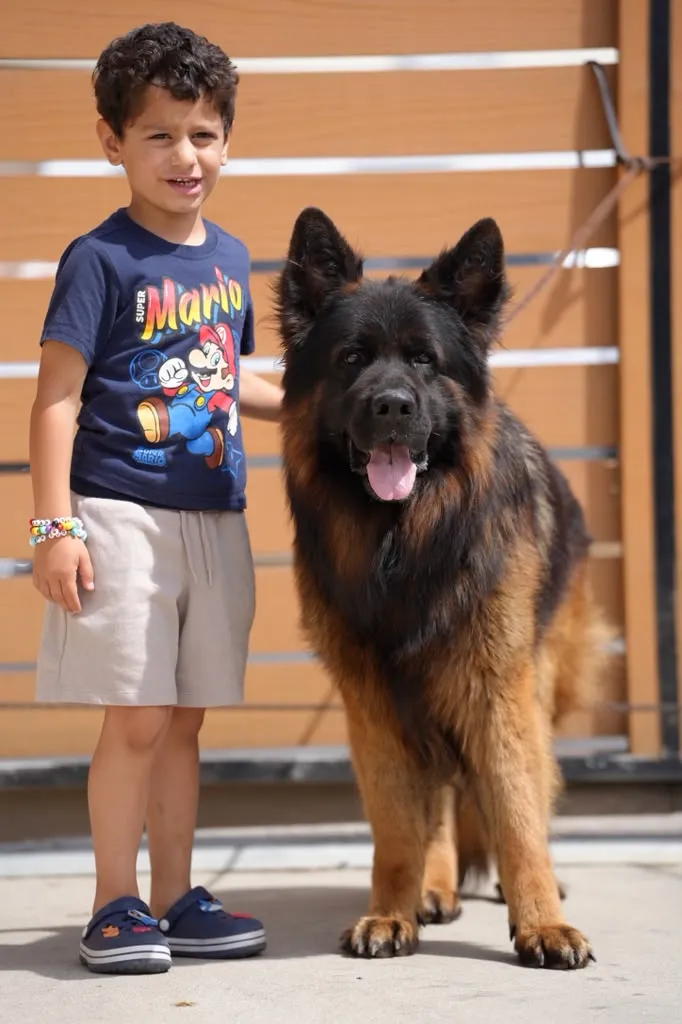
You stand up from the couch.
Your German Shepherd stands up.
You walk to the kitchen.
Four paws follow.
You turn toward the hallway.
The shadow turns too.
You go to the bathroom.
Apparently, this meeting also requires canine supervision.
If you have ever asked why does my dog follow me everywhere, you are probably not dealing with a dog that simply forgot how to sit still.
German Shepherds are naturally oriented toward people.
They watch.
They anticipate.
They learn routines quickly.
They often want to be part of whatever their person is doing.
That closeness can be one of the best parts of living with the breed.
But closeness and dependence are not the same thing.
A German Shepherd can be deeply attached to you and still be emotionally comfortable when you move across the room, close a door, or temporarily leave the house.
The difference becomes easier to understand if you stop thinking about attachment as an on/off switch.
Instead, imagine an invisible circle around you.
Your German Shepherd’s Invisible Radius
Every dog has a preferred distance from the people who matter most.
Some dogs are happy across the room.
Some want to be in the same room.
Some want to be touching you.
And some seem convinced that your ankle is a legally required resting place.
Imagine four invisible rings around your body.
| Proximity Ring | What It Looks Like |
| Ring 1 — Contact | Leaning on you, lying on your feet, constant physical touch |
| Ring 2 — Same Room | Relaxing nearby while keeping you in view |
| Ring 3 — Visual Range | Comfortable in another part of the home but occasionally checking where you are |
| Ring 4 — Independent Space | Able to rest, play, chew, or sleep without monitoring you |
A healthy German Shepherd can move between all four.
That flexibility matters more than which ring the dog prefers.
A dog that loves Ring 1 but can comfortably move into Ring 4 has strong attachment and independence.
A dog that appears unable to leave Ring 1 may need more help learning that distance is safe.
The Goal Is Not to Push Your German Shepherd Away
This is where owners sometimes misunderstand independence training.
You are not trying to make the dog care less about you.
You are not trying to turn a social German Shepherd into a detached dog.
The goal is choice.
A securely attached dog can think:
“I want to be beside you.”
A dependent dog may feel:
“I need to be beside you.”
Those sentences look almost identical from the outside.
The emotional difference is enormous.
So if you are wondering why does my dog follow me everywhere, do not begin by asking how to stop the following.
First ask whether the dog can choose not to follow.
Ring 1: The German Shepherd Who Wants Physical Contact
Some German Shepherds seem happiest when part of their body is touching yours.
A head across the foot.
A shoulder against your leg.
The entire dog somehow occupying six inches of space between you and the sofa.
This can be perfectly normal.
Physical proximity can be rewarding.
Your body is warm.
You provide attention.
You are predictable.
You are associated with food, walks, play, training, travel, and interesting things happening.
Over time, closeness itself becomes valuable.
The important question is what happens when physical contact disappears.
If you shift to another chair and the German Shepherd simply settles again, there is little reason to consider the closeness unhealthy.
If the dog becomes restless every time contact ends, the attachment radius may be unusually narrow.
Ring 2: The Same-Room German Shepherd
This is probably where many well-adjusted German Shepherds spend a large part of home life.
You work.
The dog sleeps nearby.
You cook.
The dog lies several feet away.
You watch television.
The dog has a preferred spot in the room.
The German Shepherd is socially connected without requiring constant interaction.
This is an excellent place to reinforce calm behavior.
One mistake owners make is only rewarding the dog when it approaches.
The dog comes close.
Petting happens.
The dog paws.
Attention happens.
The dog follows.
Conversation happens.
Meanwhile, the German Shepherd lying quietly ten feet away receives nothing.
Over months, we can accidentally teach:
Proximity activates humans.
That is not necessarily bad.
But if you want healthy independence, calm distance should also become rewarding.
Ring 3: “I Know Where You Are”
Now the dog does not need to occupy the same room.
You walk into the kitchen.
The German Shepherd stays in the living room.
A few minutes later, the dog may look toward the doorway.
You come back.
Nothing dramatic happens.
This is an important form of independence because the dog still feels socially connected while tolerating physical distance.
For owners wondering why does my dog follow me everywhere, this is often the first ring worth developing.
You do not need to leave the house.
You simply teach:
You moving does not always require the dog to move.
Ring 4: The Dog Has Its Own Business
This is not loneliness.
It is healthy autonomy.
Your German Shepherd may choose to:
Sleep in another room.
Lie in a sunny spot.
Work on a safe chew.
Rest in a crate or open pen.
Watch the yard.
Choose a bed that is not beside you.
The dog does not constantly monitor where every person in the household is standing.
And when you eventually return, there is no emotional crisis.
This is the outer ring of healthy independence.
The dog remains bonded.
The relationship is still strong.
The dog has simply learned that temporary distance does not threaten the relationship.
Why German Shepherds Often Prefer the Inner Rings
German Shepherds were developed as working dogs that cooperate closely with people.
That history matters.
Handler awareness is useful in a working dog.
A dog that pays attention to human movement, direction, and intention is easier to guide.
Modern family German Shepherds may not be moving livestock or completing working tasks every day, but that human orientation can still appear inside the house.
The owner walks.
The dog notices.
The owner changes rooms.
The dog assumes something may happen.
This is one reason the question why does my dog follow me everywhere is so common among German Shepherd owners.
Following is often not dysfunction.
Sometimes it is simply what a highly observant social dog does.
Your Household Can Make the Velcro Stronger
Breed tendencies are only part of the story.
Daily reinforcement can strengthen the pattern dramatically.
Think about an ordinary day.
The German Shepherd follows you into the kitchen.
A small piece of food appears.
The dog follows you toward the front door.
A walk happens.
The dog follows into the office.
You pet the dog.
The dog follows to the bedroom.
It gets invited onto the bed.
Following predicts good things.
From the dog’s perspective, monitoring you is an excellent strategy.
There is nothing mysterious about that.
The dog learned something useful.
The Bathroom Question
Many owners specifically wonder:
Why does my dog follow me everywhere—even to the bathroom?
The answer is often much less dramatic than people imagine.
You moved.
Your German Shepherd noticed.
The dog followed the pattern it uses all day.
The bathroom is only unusual from the human perspective.
To the dog, it is another room you entered.
Following you inside does not automatically mean separation anxiety.
The useful question is what happens if the door closes and the dog cannot follow.
Does the dog simply lie outside?
Walk away?
Wait quietly?
Or immediately become distressed?
That reaction tells you much more than the fact that the dog followed you there.
The Difference Between a Velcro Dog and a Dog With Separation Anxiety
A Velcro dog may want to be near you whenever you are home.
A dog with separation-related distress has difficulty coping when separation actually occurs.
Those conditions can overlap, but they are not identical.
A German Shepherd may shadow you all afternoon and then sleep peacefully after you leave.
Another German Shepherd may appear relatively independent while you are home but panic when the front door closes.
Our guide to dog separation anxiety versus boredom goes much deeper into what happens during actual owner absence.
That distinction matters because ordinary closeness should not automatically be treated like a behavioral disorder.
Build Independence by Expanding Space, Not Removing Affection
Imagine training independence like expanding the radius one step at a time.
Do not start by sending a deeply attached dog alone to the opposite side of the house for an hour.
Start with inches.
Then feet.
Then rooms.
A simple progression may look like this:
Your German Shepherd settles beside your feet.
Later, reward the dog for settling on a bed three feet away.
Then move the bed slightly farther.
Eventually the dog rests across the room.
Later, you briefly step through a doorway.
Then return before anything becomes emotionally difficult.
Eventually the German Shepherd learns that the relationship remains intact regardless of exact distance.
That is dog independence training without social rejection.
The Most Useful Piece of Furniture May Be a Dog Bed
A place cue or relaxation station can help create a physical location where independence makes sense.
The bed should not mean:
“Go away.”
It should mean:
“This is a good place to relax.”
Reward calm behavior there.
Occasionally provide a safe chew there.
Let the German Shepherd discover that interesting things can happen away from your feet.
Over time, the bed becomes a choice rather than a punishment.
This is particularly useful with German Shepherds as house dogs, because a large family dog needs both social access and the ability to settle without becoming part of every household movement.
Stop Paying the Shadow Every Single Time
You do not need to ignore your German Shepherd.
But notice what behaviors constantly receive attention.
Suppose every time the dog approaches, you speak.
Every paw gets touched.
Every nose bump earns eye contact.
Every room-to-room follow leads to interaction.
The dog may simply learn that closeness is the highest-paying behavior in the house.
Balance that system.
Sometimes reward the German Shepherd for staying on the bed when you stand up.
Drop a treat calmly between the dog’s paws for remaining settled.
Return to the room and greet the dog that chose not to follow.
Independence can become rewarding too.
The “Nothing Happened” Skill
One of the most valuable abilities for a German Shepherd is learning that not every human movement predicts an event.
You stand up.
Nothing happens.
You walk to another room.
Nothing happens.
You open a cabinet.
Nothing happens.
You put on shoes.
Sometimes you remain home.
You pick up your keys.
Sometimes you simply move them.
This makes the environment less demanding to monitor.
A dog that believes every movement contains important information has a reason to remain constantly attached to you.
Predictability can create comfort.
But excessive prediction can create a professional shadow.
Puppies Naturally Live Closer to the Center
Young German Shepherd puppies often want more proximity.
The household is new.
People are important sources of security, food, warmth, guidance, and information.
That does not mean the puppy should never experience independence.
It means the distance should match development.
Short periods resting in a safe area.
Brief separation behind a gate.
Independent chewing.
Naps away from constant activity.
The aim is not immediately teaching a puppy to tolerate long absence.
The aim is building a history where small amounts of distance feel ordinary.
Our guide to German Shepherd puppy trainability provides broader context for how quickly these dogs learn household routines—both the routines we intended to teach and the ones we accidentally created.
Adolescence Can Make the Pattern Look Different
An adolescent German Shepherd may become more independent in some situations and more demanding in others.
The dog may explore farther outdoors while still shadowing a favorite person inside.
Activity needs increase.
The dog’s understanding of household routines becomes stronger.
Learned behaviors become easier to recognize.
If following has produced attention for months, adolescence may not magically make it disappear.
At this stage, structure becomes especially important.
The dog needs opportunities to engage with the family and opportunities to disengage.
Fear Can Temporarily Shrink the Radius
Confidence is not perfectly stable throughout development.
A German Shepherd puppy going through a sensitive period may temporarily want to stay closer.
A frightening event can also change proximity behavior.
The dog that normally rests across the room may suddenly choose your feet.
That temporary change does not automatically mean the dog has developed unhealthy dependence.
Look at the bigger pattern.
Our German Shepherd puppy fear stages and dog anxiety guide explains why confidence and fear responses can shift during development.
The important part is avoiding the assumption that every period of extra closeness needs to be corrected immediately.
Senior German Shepherds May Move Back Toward the Center
A dog that was independent for years may become more attached later in life.
There are several possible reasons.
The senior dog may hear less.
Vision may change.
Mobility may become more difficult.
Pain may make familiar people more reassuring.
Cognitive changes can affect orientation.
This is why sudden new clinginess deserves more attention than a lifelong personality trait.
If your older German Shepherd suddenly begins following you constantly, do not immediately start independence drills.
Look for other changes.
Sleep.
Movement.
Appetite.
Hearing.
Vision.
Bathroom habits.
Comfort.
A veterinary evaluation may be appropriate when clinginess appears suddenly or arrives alongside physical or behavioral changes.
Healthy Attachment Does Not Mean Perfect Independence
There is no prize for owning the German Shepherd that spends the least time near you.
Some dogs simply prefer more social contact.
Temperament varies.
Family routines vary.
A German Shepherd that sleeps beside your desk every day may be completely emotionally healthy.
The goal is not maximizing distance.
The goal is maintaining flexibility.
Ask:
Can the dog relax without touching me?
Can the dog remain on a bed when I walk across the room?
Can I close a bathroom door without immediate distress?
Can the dog engage with another family member?
Can the dog rest independently?
Can normal short separations happen without panic?
Those answers tell you much more than how often your dog follows you.
The Attachment Balance Sheet
Think of attachment as two columns.
The Bond Column
The German Shepherd seeks your company.
Responds to your guidance.
Checks in with you.
Enjoys training together.
Chooses to rest nearby.
Looks to you for information.
The Independence Column
The dog can sleep without physical contact.
Can settle while you move around.
Can enjoy enrichment independently.
Can stay with another trusted family member.
Can tolerate ordinary barriers.
Can cope with appropriate periods alone.
A healthy relationship has entries in both columns.
You are not trying to empty the Bond column to fill the Independence column.
You want both to be strong.
Why Does My Dog Follow Me Everywhere but Not Other Family Members?
Sometimes one person controls most of the important resources.
That person feeds.
Walks.
Trains.
Plays.
Drives the dog places.
Opens the yard.
Gives treats.
The German Shepherd may simply have learned that this person predicts the most relevant information.
Personality matters too.
Some dogs form stronger behavioral habits around one family member.
That preference does not necessarily mean something is wrong with the dog’s relationship with everyone else.
If the household wants a more balanced attachment, other family members can participate more in feeding, training, play, walks, and calm interaction.
You Do Not Need to Constantly Entertain a Velcro Dog
A German Shepherd does not need a task every moment it is awake.
In fact, constantly keeping the dog busy can make independence harder.
The dog learns:
Human present = entertainment.
Human moves = follow.
Human sits = request interaction.
A healthy household also teaches:
Sometimes nothing happens.
Rest is allowed.
Boredom does not require immediate rescue.
Your dog can simply exist in the same home without participating in everything.
That ability to switch off is extremely valuable.
Try the Proximity Reset
Pick one ordinary part of the day.
Maybe working at a desk.
Place a comfortable dog bed several feet away.
Reward the German Shepherd for settling there.
Do not repeatedly call the dog away from you.
Do not physically keep pushing it back.
Let the bed become worthwhile.
Once the dog can relax there, gradually create small pieces of distance.
Stand up.
Sit down.
Walk across the room.
Return.
Step briefly through the doorway.
Return.
The lesson is not:
Stay away from me.
It is:
My movement does not require your movement.
That is a fundamentally different message.
When Following Becomes Worth Investigating
The phrase why does my dog follow me everywhere usually describes harmless social behavior.
But the context matters.
Pay more attention when clinginess appears suddenly.
When the dog cannot sleep unless touching you.
When visual separation produces immediate distress.
When the dog blocks doors or physically prevents movement.
When ordinary barriers cause escalating agitation.
When you cannot leave the home without panic.
Or when following arrives together with pain, disorientation, sensory changes, or other abnormal behavior.
At that point, the issue is no longer simply whether the dog is affectionate.
You need to understand what is driving the behavior.
Do Not Punish the Shadow
Following is rarely something a German Shepherd is doing to challenge you.
Punishing the dog for wanting proximity can make the owner less predictable and may increase insecurity.
Healthy independence is better taught through successful distance.
Reward calm settling.
Provide attractive resting locations.
Practice manageable separation.
Let other family members become valuable.
Create a dog that knows how to relax.
That approach changes behavior without damaging the relationship you were trying to balance.
Why German Shepherd Attachment Can Be a Strength
The same qualities that produce a Velcro dog can be incredibly useful.
Handler awareness supports training.
Attention improves communication.
Social connection can strengthen recall work.
A German Shepherd that naturally watches its owner may learn household rules quickly.
This is one reason strong attachment should not automatically be treated as a problem.
The objective is channeling it.
A dog can be attentive without being dependent.
Connected without being anxious.
Close without being unable to cope with distance.
That balance is one of the best outcomes of thoughtful German Shepherd ownership.
Frequently Asked Questions
Why Does My Dog Follow Me Everywhere?
Dogs may follow because of social attachment, habit, reinforcement, curiosity, routine, or breed tendencies.
For German Shepherds, strong handler orientation can make room-to-room following especially common.
The key question is whether the dog can also settle comfortably without constantly remaining beside you.
Is a Velcro Dog Unhealthy?
Not necessarily.
A Velcro dog may simply strongly prefer proximity.
It becomes more concerning when the dog cannot function comfortably without maintaining contact or becomes significantly distressed when separation occurs.
Do German Shepherds Naturally Follow Their Owners?
Many German Shepherds are highly attentive to their handlers and household routines.
Individual temperament still varies considerably, so some will be much more physically attached than others.
Does Following Me Everywhere Mean Separation Anxiety?
No.
Following while you are home and distress when you leave are different behaviors.
A German Shepherd can be extremely clingy while you are home and remain perfectly calm during absence.
How Do I Make My German Shepherd More Independent?
Build independence gradually.
Reward resting away from you, create comfortable independent spaces, allow calm activities without constant interaction, and practice short manageable periods of distance.
Avoid suddenly forcing long isolation.
Why Has My Older German Shepherd Suddenly Become Clingy?
Sudden behavioral change can sometimes accompany pain, hearing or vision changes, illness, or age-related cognitive changes.
If the behavior is genuinely new—especially with other changes—consider discussing it with your veterinarian.
Should I Stop My German Shepherd From Following Me?
Usually there is no need to eliminate the behavior completely.
Focus on whether the dog can also choose independent behavior.
The healthiest target is flexibility rather than distance for its own sake.
The Best Bond Has Elasticity
If you keep asking why does my dog follow me everywhere, the answer may simply be that your German Shepherd likes being where you are.
That is not something you need to remove.
The question becomes more useful when you change one word:
Not:
“Why does my dog stay close?”
But:
“Can my dog feel safe when close is temporarily unavailable?”
A healthy bond stretches.
Your German Shepherd can lie against your leg.
Then sleep across the room.
Then remain comfortable when you walk through a doorway.
Then greet you when you return.
The connection remains.
The distance changes.
That is healthy independence.
You do not need a less attached German Shepherd.
You need a German Shepherd whose attachment is strong enough that a few feet—or a closed door—does not make the relationship feel uncertain.