Dog body language rarely starts with the dramatic behavior people remember.
It usually starts earlier.
Before the bark.
Before the growl.
Before the leash tightens.
Before a German Shepherd refuses to move, lunges, or snaps.
The first change may last less than a second.
A mouth that suddenly closes.
A quick turn of the head.
A tongue flick when there is no food nearby.
A body that was moving normally and suddenly becomes still.
A dog that normally takes food eagerly but now hesitates.
Those moments are easy to miss because none of them look dramatic by themselves.
So instead of treating stress signals as a list of isolated gestures, spend one ordinary day following a German Shepherd and watch how the dog’s body changes as the environment changes.
The useful information is rarely one pose.
It is what changed between one moment and the next.
6:45 AM — Before Anything Happens
The house is quiet.
Your German Shepherd wakes up, stretches, walks toward the kitchen, drinks some water, and settles nearby.
Nothing important is happening.
That makes this part of the day extremely useful.
This is your baseline.
The mouth is loose.
The eyes move easily around the room.
The ears respond casually to household sounds.
The body is balanced rather than pushed forward or leaning away.
Movement looks fluid.
The dog lies down without repeatedly getting back up to inspect the room.
If you want to understand dog body language, this ordinary version of your dog matters more than any online chart.
Later, you should not simply ask:
“Are his ears back?”
Ask:
“Did his ears move from where they normally were when this situation began?”
The same applies to the mouth, tail, posture, eyes, and movement.
Stress signals become much more useful when they are measured against the individual dog rather than against a generic illustration.
7:30 AM — The Sidewalk Looks Normal Until It Doesn’t
The morning walk begins as usual.
Your German Shepherd moves ahead.
Sniffs a tree.
Checks the grass.
Walks several steps.
Investigates another scent.
Then another dog appears at the far end of the sidewalk.
Your German Shepherd does not bark.
There is no growl.
The leash is still loose.
If obvious reactions are the only thing you watch for, this moment looks uneventful.
But compare it with ten seconds earlier.
The sniffing stops.
The slightly open mouth closes.
The head comes up.
The eyes remain on the other dog.
The ears orient toward it.
Movement becomes slower.
The body seems just a little taller and more fixed.
Nothing explosive has happened.
But the picture has changed.
That early information is valuable because you still have options.
Cross the street.
Change direction.
Create more space.
Let your German Shepherd process the other dog from a distance where thinking is still possible.
This is also where good German Shepherd behavior training becomes more effective: timing matters as much as the cue itself, and reading the dog early allows training to happen before the environment becomes overwhelming.
7:32 AM — The Tongue Flick You Could Easily Miss
You create a little more distance.
Your German Shepherd glances toward the other dog.
Then the tongue briefly passes across the nose.
It lasts less than a second.
Taken by itself, that tells you very little.
Dogs lick their lips after food.
They lick because of smells.
They make ordinary mouth movements.
But there is no food here.
And the tongue flick appeared alongside a closed mouth, narrowed attention, altered posture, and a difficult environmental change.
Now it becomes more useful.
This is one of the central rules of dog body language:
Do not translate one movement. Read the cluster.
Lip licking = stress is too simple.
A better interpretation is:
Lip licking + altered posture + reduced exploration + difficult context may indicate increasing discomfort or arousal.
The combination matters.
7:36 AM — Distance Changes the Picture Again
You move farther away from the other dog.
Now something else changes.
Your German Shepherd looks once more.
Then lowers the nose toward the ground.
Sniffing begins again.
The mouth loosens.
Movement becomes less rigid.
A treat that was ignored thirty seconds earlier is now accepted.
This is important because recovery is part of dog body language too.
The question is not only:
“What did the dog do when pressure increased?”
Also ask:
“What happened when pressure decreased?”
If a little more distance quickly brings the German Shepherd back toward normal behavior, you have learned something practical about that dog’s current comfort level.
9:20 AM — A Visitor Reaches Toward the Head
Later that morning, the doorbell rings.
A familiar visitor enters.
Your German Shepherd walks toward the person.
The visitor speaks warmly and reaches directly over the dog’s head.
The German Shepherd does not bark.
It does not run away.
It remains standing.
Someone might interpret that as perfect comfort.
But watch more carefully.
The head turns slightly away from the approaching hand.
The eyes stay on the visitor.
The mouth closes.
One ear shifts backward.
The dog’s weight moves subtly away even though the paws stay where they are.
Then comes another quick lip lick.
The visitor continues petting.
The German Shepherd becomes very still.
Someone says:
“He’s so calm.”
Maybe.
But quiet behavior and comfortable behavior are not automatically the same thing.
9:21 AM — Let the Dog Answer a Question
The visitor stops touching the dog.
Nobody calls the German Shepherd back.
Nobody reaches again.
Now watch what happens.
The dog may step closer and request more contact.
That gives you information.
Or the German Shepherd may turn away, shake, sniff the floor, or choose another location.
That also gives you information.
The pause gives the dog a chance to participate in the interaction.
This matters especially with large dogs because physical restraint, familiarity, and training can cause a dog to remain in place even when the dog would prefer more space.
Understanding these subtleties also improves German Shepherd obedience training, because a dog that knows a cue may still respond differently when discomfort, fear, or environmental pressure changes its ability to concentrate.
Obedience should not be used to erase information from the dog.
It should work alongside that information.
10:05 AM — The Full-Body Shake
The visitor sits down.
Your German Shepherd walks away and performs a full-body shake from head to tail.
The coat is dry.
Was the shake caused by stress?
You cannot know from that movement alone.
Ask a better question:
What just ended?
A shake-off may appear after social pressure, physical handling, restraint, excitement, or another stimulating interaction.
That makes it useful as a possible transition marker.
The interaction changed.
Then the dog’s body changed.
Again, meaning comes from sequence.
Not from one gesture isolated from everything around it.
11:40 AM — Watch What Real Recovery Looks Like
The visitor leaves.
The house becomes quiet.
Your German Shepherd goes to a familiar resting place.
This time, the dog actually sleeps.
The body loosens.
Breathing settles.
The head stays down.
The dog changes sleeping position without repeatedly scanning the room.
This is another baseline worth remembering.
Owners often spend so much time looking for stress that they forget to learn what complete recovery looks like.
That matters because two German Shepherds can react similarly to an event but recover very differently afterward.
A dog that returns to normal quickly gives you different information from a dog that remains restless, hypervigilant, or unable to settle long after the trigger disappears.
1:15 PM — Grooming Begins Normally
After lunch, the brush comes out.
Your German Shepherd knows the routine.
You brush the shoulders.
No problem.
The back.
The dog remains loose.
The chest.
Still normal.
Then you move toward one rear leg.
The German Shepherd turns the head toward your hand.
You continue.
There is a quick tongue flick.
The dog shifts the foot.
You reposition it.
Another small movement.
A yawn.
Then the entire body becomes noticeably still.
There is no growl.
No snap.
No attempt to bite.
But compare this frame with the beginning of the grooming session.
Something changed.
1:17 PM — Do Not Test the Dog; Test the Situation
Owners sometimes respond to subtle discomfort by pushing farther.
“Let me see if he’s really bothered.”
That is usually the wrong experiment.
Instead, pause.
Release the paw.
Give your German Shepherd a moment.
If the dog immediately moves away and avoids re-engaging, that gives you useful information.
If the dog stays close, relaxes, and willingly continues, that also gives you information.
Good handling should involve observation, not forcing the dog to escalate before its message is believed.
And if a German Shepherd suddenly becomes sensitive around a body part that previously caused no problem, think beyond training.
Pain can alter behavior.
So can skin irritation, joint discomfort, an ear problem, injury, or other physical changes.
Behavior can sometimes be the first clue that something changed physically.
2:30 PM — The Same Yawn Can Mean Different Things
Your German Shepherd wakes from a nap and yawns.
Completely ordinary.
Later, during nail handling, the dog yawns again.
Then turns the head away.
Licks the lips.
Shifts backward.
Now the same physical movement appears inside a completely different context.
This is why a list titled “10 signs of stress in dogs” can be misleading when readers treat each item as a diagnosis.
Yawning is not automatically stress.
Lip licking is not automatically stress.
Looking away is not automatically fear.
The meaning comes from timing, context, change from baseline, and the other behaviors occurring at the same time.
3:50 PM — A Child Runs Into the Room
Your German Shepherd is resting.
A child approaches quickly.
The dog’s eyes open.
The child kneels beside the dog.
Your German Shepherd turns the head away.
The child moves closer.
A quick tongue flick.
The child puts both arms around the dog’s neck.
The German Shepherd stops moving.
Completely.
No bark.
No growl.
The tail may even move slightly.
This is one of the moments where humans often miss quiet communication.
The question should not be:
“Did he growl?”
The better question is:
“Did he need to growl before somebody listened?”
Create space calmly.
Do not punish the dog.
Do not repeat the interaction to test tolerance.
A stable German Shepherd still deserves supervised, respectful interactions.
Understanding everyday family situations like this is also part of understanding German Shepherds as house dogs. Living successfully inside the family home involves more than obedience—it includes rest, personal space, handling, children, visitors, and the ability to settle without constant pressure.
3:51 PM — Stillness Can Be Louder Than Movement
A moving dog suddenly becomes motionless.
That deserves attention.
But once again, context decides what the stillness means.
A German Shepherd waiting for a ball may freeze in anticipation.
A dog hearing a distant sound may pause to listen.
A working dog may become still during intense concentration.
Now compare those situations with a dog that freezes while another person continues unwanted physical contact.
The posture looks similar from a distance.
The situation is completely different.
This is why reading dog body language means reading the dog and the environment together.
4:40 PM — The Tail Is Not a Happiness Meter
Later, another family member arrives home.
Your German Shepherd approaches.
Tail moving.
Body loose.
Movement wide and easy.
The dog voluntarily closes the distance.
Compare that picture with the earlier interaction involving the child.
The tail may have moved there too.
But the rest of the dog did not look the same.
A wagging tail does not automatically mean:
“I’m happy.”
Or:
“Please touch me.”
Tail height, speed, range, muscle tension, overall posture, facial expression, and voluntary approach all matter.
A tail should never be interpreted without the dog attached to it.
5:45 PM — The Evening Walk Tells a Different Story
The second walk begins.
Morning conditions are gone.
Since then, the German Shepherd experienced a visitor, grooming, nail handling, a child interaction, household activity, and less uninterrupted rest than usual.
Another dog appears across the street.
The distance is similar to the morning encounter.
But your German Shepherd reacts differently.
The mouth closes immediately.
The body becomes taller.
The stare is harder.
Food loses value faster.
The leash tightens.
This is another important lesson.
Your German Shepherd does not necessarily begin every interaction from the same emotional state.
A dog that successfully handled a situation this morning may find the same situation harder later.
That is why owners should respond to the dog in front of them today—not to what the dog handled yesterday.
6:10 PM — How the Dog Takes Food Can Matter
You offer a treat.
Your German Shepherd normally takes food gently.
This time it is grabbed quickly.
Later, another treat is refused.
Many owners use food as a simple yes-or-no test:
“He took food, so he’s okay.”
But food response has nuance.
Did the way the dog took the food change?
Normally eager dog suddenly hesitates.
Normally gentle dog begins grabbing.
Normally food-motivated dog takes the treat but cannot disengage visually from the environment.
These differences can provide additional context.
They are not standalone diagnoses.
They are changes from normal.
7:05 PM — Home Behavior Is Still Body Language
Back inside, your German Shepherd follows you from the kitchen to the office.
Then into another room.
Is that stress?
Not necessarily.
German Shepherds often pay close attention to household movement.
They are social, observant, handler-oriented dogs.
Inside normal family life, German Shepherds as house dogs may choose to remain near their people while still being perfectly comfortable and independent.
Watch the quality of the behavior.
A German Shepherd casually getting up and moving into the same room is one picture.
A dog panting, pacing, unable to settle, and urgently monitoring every human movement is another.
The visible behavior—following—can look similar.
The rest of the body changes the interpretation.
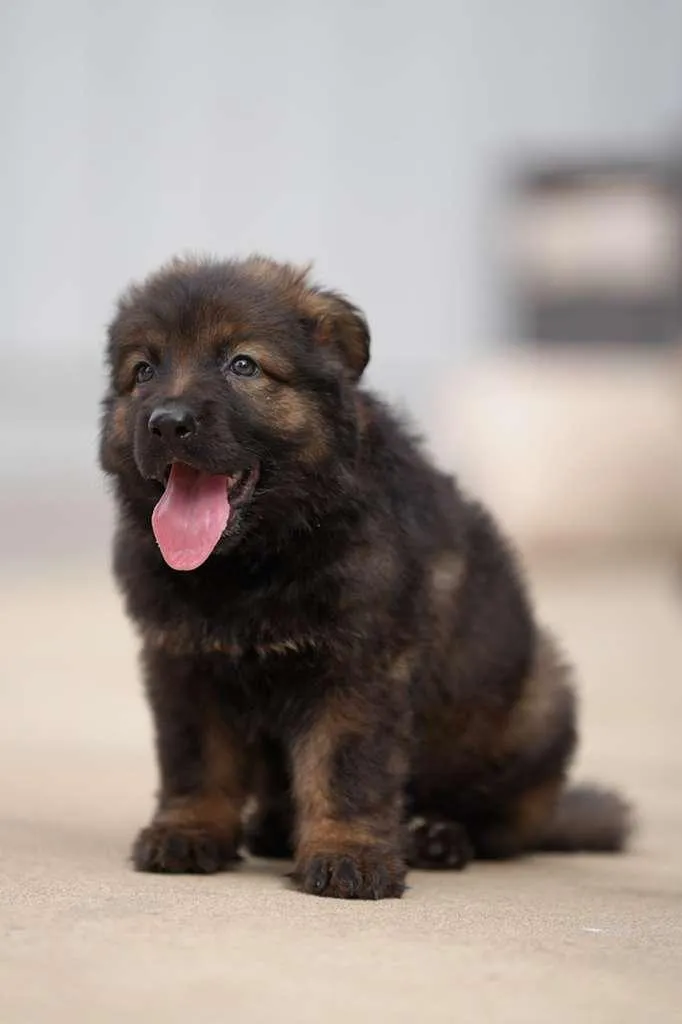
8:00 PM — Puppies Add Another Layer
Now imagine the dog from today’s story is not an adult.
It is a young German Shepherd puppy.
A puppy may suddenly appear more cautious around noises, unfamiliar people, new surfaces, or handling.
The owner may immediately assume that training is failing.
But development matters.
So do sleep, overstimulation, physical fatigue, and how much novelty the puppy experienced that day.
That is why age-appropriate exercise for German Shepherd puppies matters when interpreting behavior. Too little activity can create problems, but too much physical and environmental stimulation can also leave a puppy overtired and less able to cope with new situations.
The important question is not simply:
“Did the puppy look nervous?”
Ask:
Did confidence return when the situation became easier?
Could the puppy explore again?
Could the puppy eat?
Could the puppy rest afterward?
Developmental context matters.
8:45 PM — The Day Ends With the Most Important Picture
The house becomes quiet again.
Your German Shepherd walks toward a familiar bed.
The mouth is loose.
Eyes soften.
The body stretches.
The dog settles onto one side.
Breathing becomes slow and regular.
A few minutes later, sleep begins.
This last frame helps interpret everything that happened before it.
Think back through the day.
The same German Shepherd:
Changed posture on the morning walk.
Licked its lips during pressure.
Moved away from a visitor.
Shook after social contact.
Became still during grooming.
Froze when hugged.
Found the evening dog encounter harder than the morning one.
Changed the way food was taken.
Followed family members through the house.
Not every one of those behaviors meant stress.
Their meaning came from what happened before, what happened alongside them, and what happened afterward.
That is the difference between seeing movement and reading dog body language.
Replay the Day: 9 Clues That Were Easy to Miss
| Subtle Change | Context | Why It Mattered |
| Mouth suddenly closed | Another dog appeared | Changed from relaxed exploration |
| Sniffing stopped | Morning walk | Attention narrowed |
| Lip licking | Dog encounter / handling | Appeared without food during pressure |
| Head turned away | Visitor reached toward dog | Social pressure increased |
| Weight shifted backward | Visitor interaction | Suggested desire for more space |
| Full-body shake | After visitor | Appeared as interaction ended |
| Repeated yawning | Handling | Appeared with other behavioral changes |
| Sudden freeze | Child hug | Occurred during escalating pressure |
| Food response changed | Evening walk | Different from the dog’s normal pattern |
The table gives us the 9 clues promised in the SEO title, but it is a summary of the story—not another article built as “9 signs.”
Before You Interpret Any Dog Body Language
Use one simple rule:
Baseline → Change → Context → Cluster → Recovery
Baseline tells you what normal looks like.
Change tells you something happened.
Context helps explain when it happened.
Cluster prevents you from diagnosing from one movement.
Recovery tells you how much the situation may have affected the dog.
That sequence is more useful than memorizing dozens of body-language graphics.
When Better Training Changes What You Can See
Body language and training are not separate topics.
Good German Shepherd behavior training makes communication clearer because owners learn to observe the dog before asking for more difficult behavior.
Likewise, German Shepherd obedience training is most effective when the dog remains capable of processing information.
A cue the dog performs easily in a quiet kitchen may become much harder when the environment is overwhelming.
That does not automatically mean the German Shepherd forgot the training or decided to disobey.
Sometimes the owner changed the difficulty faster than the dog could adapt.
When the Problem May Be Physical
Suppose your German Shepherd has always enjoyed being brushed around the hips.
Now the dog turns away.
Tenses.
Perhaps licks the lips.
Eventually growls when the same area is touched.
Do not automatically interpret that as a training problem.
Pain can alter:
Posture.
Movement.
Sleep.
Social tolerance.
Handling tolerance.
Reaction thresholds.
If a behavioral change is sudden, persistent, or connected with movement or touch, veterinary evaluation may be appropriate.
Especially if you also notice changes in appetite, activity, gait, sleep, or bathroom habits.
When Professional Behavior Help Makes Sense
Reading body language is useful for everyday ownership.
It does not make every difficult behavior a home project.
If your German Shepherd repeatedly attempts to bite, has bitten, redirects onto the handler, guards resources dangerously, or cannot be safely managed around known triggers, seek qualified professional support.
The goal of understanding stress signals is earlier, safer intervention.
Not waiting until the dog reaches the loudest possible response.
Questions Owners Ask About Dog Body Language
What Are Common Dog Stress Signals?
Possible stress-related changes include lip licking, looking away, altered posture, sudden stillness, unusual panting, pacing, changes in ear position, altered food response, attempts to create distance, or changes in normal movement.
One signal by itself does not prove stress.
Does Lip Licking Always Mean Stress?
No.
Dogs lick their lips for many normal reasons.
It becomes more meaningful when it repeatedly appears during a difficult interaction alongside other changes in dog body language.
Does Whale Eye Mean My German Shepherd Is About to Bite?
No.
Seeing more of the white of the eye can occur during uncomfortable situations, but it is not a prediction of biting by itself.
Read the eyes with posture, facial tension, movement, context, and the dog’s ability to leave.
Does a Wagging Tail Mean My German Shepherd Is Friendly?
Not necessarily.
Tail movement should be interpreted with the rest of the dog’s body.
A loose body and broad flowing tail movement create a different picture from a rigid dog with an intense stare and tight tail movement.
Why Does My German Shepherd Freeze?
Dogs become still for many reasons, including attention, anticipation, fear, uncertainty, conflict, or concentration.
A sudden freeze during escalating handling or social pressure deserves attention.
Why Does My German Shepherd Yawn When Not Tired?
Yawning may appear during stress or uncertainty, but dogs also yawn for ordinary reasons.
Its meaning depends on what else is happening.
Should I Stop an Interaction When I See One Stress Signal?
Not necessarily.
Instead, examine the whole picture.
If multiple changes occur together and pressure continues increasing, pausing the interaction or creating space may help prevent escalation.
Your German Shepherd Usually Speaks Before It Shouts
The loud behaviors are easy to notice.
Everyone hears a bark.
Everyone notices a lunge.
Everyone understands that a growl means something changed.
The better skill is seeing what happened before that point.
The mouth closing.
The sniffing stopping.
The weight moving backward.
The head turning.
The dog becoming still.
The treat being taken differently.
Recovery taking longer than normal.
That is where dog body language becomes valuable.
Not because every small movement has a fixed translation.
Because changes create information.
Know the baseline.
Watch what changes.
Look at the context.
Read several signals together.
Then watch recovery.
Once you begin doing that, many German Shepherd behaviors that once seemed to happen “out of nowhere” become much easier to understand.
The dog was communicating.
The message simply started quietly.