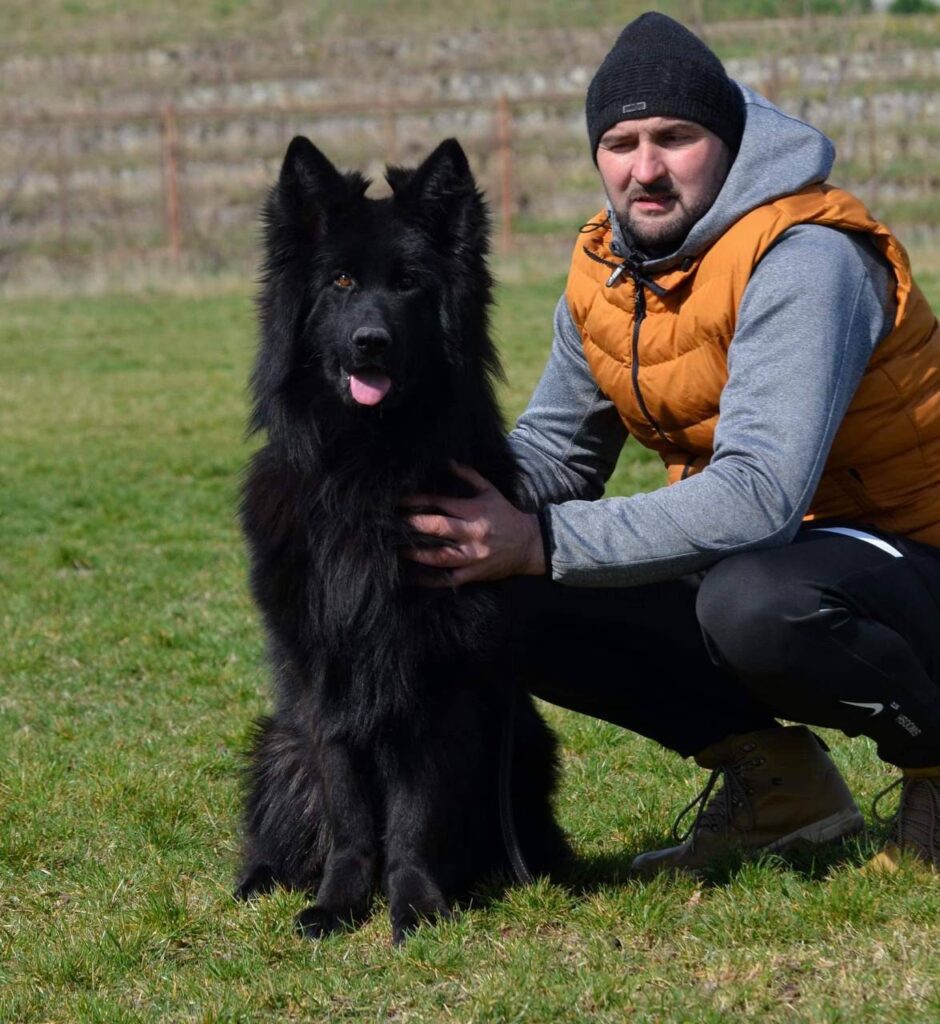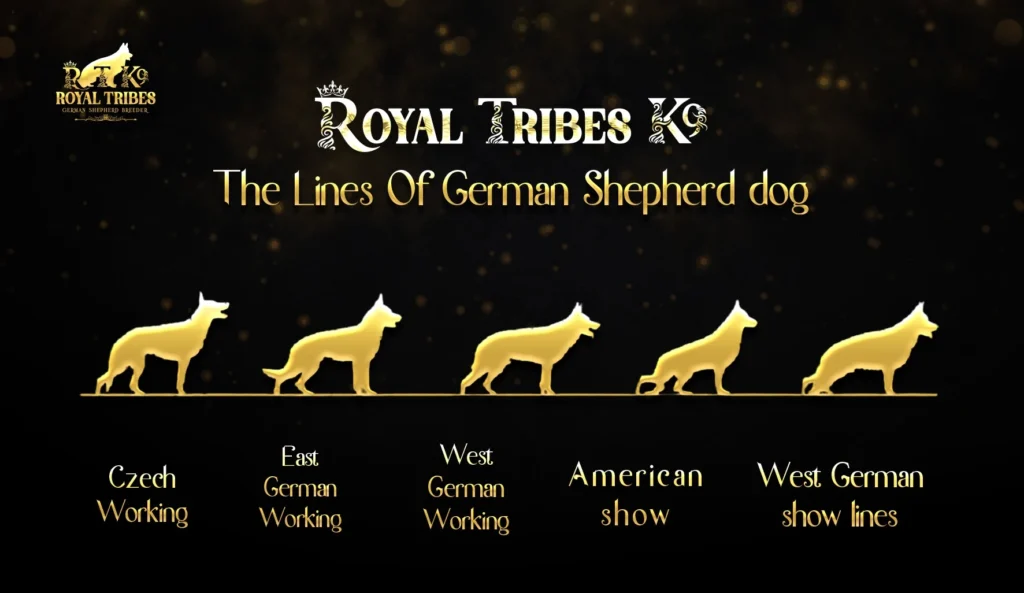

Genotype vs phenotype explains why looking at a German Shepherd can give you valuable information while still leaving a large part of the genetic story invisible.
Picture two adult German Shepherds standing next to each other.
Both are black and red.
Both have long coats.
Their height is similar.
Their movement looks balanced.
Their overall breed type is similar.
A buyer might reasonably think:
“Genetically, these dogs must be almost the same.”
Not necessarily.
One may carry genetic variants the other does not.
Their pedigrees may come from very different families.
Their degree of relatedness to a potential mate may be completely different.
One may carry a recessive variant that has never appeared visibly in that dog.
And characteristics that look nearly identical today may have developed through somewhat different combinations of genetics, environment, nutrition, training, and chance.
That is why appearance matters in breeding—but appearance is not the entire breeding record.
The Two-Dog Test
Start with an imaginary German Shepherd named Atlas.
Atlas has strong pigmentation, a long coat, confident movement, and a stable temperament in everyday life.
Beside him stands another male named Nero.
To the average observer, Nero appears remarkably similar.
Now cover the dogs and replace them with their records.
Atlas and Nero may suddenly look far less alike.
| What the Eye Saw | What the Records May Reveal |
| Similar coat | Different underlying genetic variants |
| Similar color | Different hidden color alleles |
| Similar movement | Different family histories |
| Similar body size | Different growth histories |
| Healthy appearance | Different carrier status |
| Similar temperament | Different inherited tendencies and life experiences |
| Similar breed type | Very different pedigrees and relatedness |
That gap between the visible dog and the inherited information behind the dog is the practical value of understanding genotype vs phenotype.
From DNA to the Dog Standing in Front of You
Instead of thinking of genetics as a simple switch, imagine information moving through a pipeline.
DNA → inherited possibilities → development → environment → measurable traits
The genotype sits near the beginning.
The phenotype is what eventually becomes observable or measurable.
That sounds simple until real dogs enter the picture.
A German Shepherd does not develop in a laboratory.
The puppy grows.
Eats.
Exercises.
Learns.
Experiences stress.
Receives veterinary care.
Interacts with people and dogs.
Ages.
Possibly experiences illness or injury.
All of those factors can affect parts of the phenotype.
So the relationship is not:
genotype = appearance
It is closer to:
genotype + biological development + environment = phenotype
For some simple inherited traits, genetics can be highly predictive.
For complex traits, the relationship can be much more complicated.
Genotype: The Information the Dog Carries
When breeders discuss genotype, they are discussing genetic information inherited by the dog.
Depending on the context, genotype can refer to the alleles present at one particular genetic location or more broadly to the dog’s genetic makeup.
A dog carries two copies of many autosomal genes—one inherited through the sire and one through the dam.
Those copies may be the same.
Or they may be different.
This becomes particularly important with recessive inheritance.
A dog can carry a recessive variant without visibly expressing the associated phenotype.
Nothing in the dog’s appearance necessarily announces:
“I carry this allele.”
Yet the information may still be passed to offspring.
That hidden layer is one reason genotype vs phenotype matters in a breeding program.
Phenotype: The Dog You Can Observe
Phenotype is broader than appearance alone.
It includes observable or measurable characteristics.
In a German Shepherd, examples can include:
Coat appearance.
Color.
Adult height.
Body proportions.
Movement.
Muscle development.
Certain measurable health characteristics.
Observed behavioral characteristics.
The phenotype is therefore extremely important.
Breeders need real dogs—not just DNA results.
They need to evaluate whether the breeding program is actually producing the desired characteristics.
But the phenotype shows expression.
It does not reveal every genetic possibility hidden underneath.
The Evidence Board
Imagine a breeder evaluating a potential sire.
Instead of placing everything into one folder labeled “good dog,” separate the evidence.
Board A: What Can Be Seen
Structure.
Coat.
Color.
Movement.
Size.
General breed type.
Board B: What Can Be Observed Over Time
Temperament.
Trainability.
Recovery from stress.
Working ability.
Behavior around people.
Behavior around other dogs.
Board C: What Requires Records or Testing
Pedigree.
Health certifications.
DNA results.
Carrier status.
Relatedness.
Family longevity.
History of previous offspring.
None of these boards is enough alone.
A thoughtful breeding decision compares all three.
That is the practical heart of genotype vs phenotype.
The Coat-Color Laboratory
Coat color is one of the easiest ways to understand the difference.
Imagine a German Shepherd whose visible coat is black and red.
That is phenotype.
But the visible result does not necessarily reveal every allele the dog carries at every color-related locus.
A dog can carry genetic information that does not appear in its own coat.
When bred, some of that hidden information may become relevant depending on the genotype of the mate.
So a breeder asking only:
“What color is this dog?”
has only answered a phenotype question.
The breeding question is larger:
“What does this dog carry, and what does the other parent carry?”
This principle extends beyond color.
The Long-Coat Laboratory
Now look at a long-coat German Shepherd.
The phenotype is obvious.
The dog has a long coat.
But the breeder still cannot treat the dog as a single genetic trait.
The same dog also carries thousands of variants unrelated to coat length.
Health-related variants.
Color-related variants.
Genetic contributions to complex physical traits.
Ancestry inherited from both sides of the pedigree.
Two long-coat German Shepherds can therefore share that obvious phenotype while differing substantially elsewhere genetically.
This is why breeding two dogs because they both display one desired characteristic is not a complete breeding strategy.
The Size Laboratory
Adult size provides a different lesson.
Imagine two genetically related German Shepherds with similar potential for adult size.
One grows under ideal nutritional conditions and remains lean during development.
The other experiences nutritional imbalance, illness, or a very different growth environment.
Their eventual measurements may not be identical.
Many body characteristics are influenced by numerous genes plus environmental factors.
So when buyers ask:
“How big will this puppy definitely become?”
the breeder can use parents, relatives, previous litters, sex, developmental history, and breed norms to improve the estimate.
But complex biology prevents perfect prediction.
Understanding genotype vs phenotype helps explain why.
The Structure Laboratory
Structure is a phenotype.
Breeders can evaluate angles, proportions, feet, topline, overall balance, and movement.
But the inheritance of structural traits is generally more complicated than one dominant gene and one recessive gene.
Multiple genes can contribute.
Growth affects the final result.
Nutrition matters.
Body condition matters.
Exercise and injury can affect how the dog moves.
That does not mean structure is not inherited.
It means breeders improve prediction by studying families, not just one dog.
One beautifully structured German Shepherd is useful information.
A family repeatedly producing good structure is stronger evidence.
The Temperament Laboratory
Temperament shows why a simple genotype-versus-phenotype diagram can become complicated in real dogs.
Genetics matters.
So does early development.
Maternal environment.
Socialization.
Training.
Learning history.
Stress.
Owner handling.
Life experience.
Health.
A confident adult German Shepherd may have inherited useful behavioral tendencies while also benefiting from excellent development and training.
Likewise, poor experiences can change how genetic potential is expressed.
That makes statements like:
“The father is confident, so every puppy will have the same temperament.”
far too strong.
Breeding can shift probability.
It cannot copy and paste one parent’s adult behavior into every puppy.
The Health Laboratory
A dog can look perfectly healthy and still carry genetic information relevant to breeding.
This is one of the most important places where genotype vs phenotype becomes practical.
Suppose a condition is associated with a recessive variant.
A carrier with one copy may show no disease phenotype.
From appearance alone, the dog looks unaffected.
But carrier information can matter greatly when selecting a mate.
This is why German Shepherd health testing adds information that a photograph, show result, or physical examination cannot always provide.
Appearance remains valuable.
Testing reveals another layer.
A Healthy-Looking Dog Is Not a Complete Genetic Report
There is a phrase buyers sometimes hear:
“Look at him. He is completely healthy.”
The observation has value.
A healthy adult phenotype is useful information.
But it does not answer every genetic question.
A visually healthy dog may still carry recessive variants.
It may also have relatives with health patterns that have not appeared in that individual.
Conversely, a genetic test showing “clear” for several variants does not prove that the dog is genetically perfect.
No test panel examines every possible health issue or every gene that may influence complex disease.
Both extremes miss the point.
Phenotype adds information.
Genotype adds information.
Neither equals the entire dog.
The Pedigree Adds Time to the Picture
An individual dog is one moment.
A pedigree stretches the observation across generations.
This is why a German Shepherd pedigree becomes more useful when the names are connected to real knowledge.
How long did the ancestors live?
What were their temperaments?
What did their siblings develop?
What did they produce?
Which traits repeatedly appeared?
Were certain health issues concentrated in one branch?
Did a particular characteristic remain consistent across generations?
A pedigree alone does not tell you those answers.
But it provides the structure needed to ask the questions.
The Family Repeat Test
Suppose you have two males.
Male A is spectacular.
But his siblings vary dramatically in the trait you care about.
His parents were average for that trait.
His previous offspring are inconsistent.
Male B is slightly less impressive individually.
But his parents show the trait.
His siblings show it.
His previous offspring frequently show it.
For breeding purposes, Male B may offer valuable information that cannot be seen from comparing the two males alone.
That does not make individual phenotype unimportant.
It demonstrates why repeatability across a family can help breeders estimate how strongly genetics contributes to an observed characteristic.
What Genotype vs Phenotype Says About Prediction
Breeding is partly an exercise in prediction.
A breeder studies available evidence and tries to increase the probability of a desired outcome.
But different predictions carry different levels of confidence.
| Prediction | What Helps Improve Confidence |
| Possible coat outcome | Known parental genotypes |
| Adult appearance | Parents + extended family + puppy development |
| Adult size | Sex + parents + relatives + growth history |
| Health risk | Testing + pedigree + family history |
| Temperament | Family tendencies + puppy behavior + development |
| Structural traits | Parents + relatives + previous offspring |
| Genetic diversity | Pedigree depth + relatedness + genomic information |
The more complex the characteristic, the less useful a single piece of evidence becomes.
The DNA-Test Trap
DNA testing is powerful.
But it can create a new misunderstanding:
“We tested the DNA, so we now know everything.”
We do not.
A DNA panel can provide reliable information about the variants included in that test.
That can be extremely useful.
But it does not automatically measure every disease risk.
It does not evaluate structure.
It does not watch movement.
It does not evaluate the entire temperament.
It does not tell the breeder whether two dogs complement each other phenotypically.
And it does not erase the value of pedigree and family history.
The DNA report sees a genetic layer.
The breeder still needs to evaluate the dog.
The Appearance Trap
The opposite mistake is selecting almost entirely by phenotype.
A beautiful German Shepherd can attract enormous attention.
Correct type.
Beautiful coat.
Rich pigmentation.
Powerful movement.
Strong presence.
But breeding decisions require questions that photographs cannot answer.
What does the dog carry?
How is the dog related to the proposed mate?
What does the family produce?
What health information exists?
What weaknesses also appear in the pedigree?
This is why visual excellence should begin an investigation, not end it.
The Pedigree Trap
Pedigrees can create their own illusion.
A pedigree filled with famous names can feel like proof of quality.
It is not.
Names tell you ancestry.
Titles may provide useful evidence about achievement.
But the current breeding decision still involves two living dogs with their own phenotypes, genotypes, health information, strengths, and weaknesses.
A famous ancestor does not guarantee every descendant inherited the same combination of genes.
Inheritance reshuffles genetic information every generation.
The pedigree gives context.
The dog in front of you still needs evaluation.
Relatedness Is Invisible in a Photograph
Now imagine two German Shepherds that look like an excellent pair.
Their structures complement one another.
Both have desirable temperaments.
Both have good health information.
Visually, the match makes sense.
But a deeper pedigree reveals repeated shared ancestry.
That information cannot be seen in the phenotype.
The coefficient of inbreeding (COI) examines a different part of the breeding decision: genetic relatedness through ancestry.
It does not replace phenotype.
It adds a layer the eye cannot provide.
Two Dogs Can Look Different Yet Be Closely Related
The reverse can happen too.
One dog is black.
One is black and red.
One has a long coat.
The other does not.
To a casual observer, they appear quite different.
Yet their pedigrees may share many of the same ancestors.
Phenotypic difference does not prove genetic distance.
This is why strategies involving linebreeding and outcrossing should be evaluated through pedigree relationships rather than appearance alone.
Looks tell you what was expressed.
Pedigree tells you where the dogs came from.
Genetic Diversity Lives Behind the Dogs You See
A breeding population can gradually become genetically concentrated even while producing dogs with varied appearances.
Color variation is not the same thing as genome-wide diversity.
Different coats do not automatically mean unrelated families.
Different kennel names do not automatically mean unrelated pedigrees.
Maintaining genetic diversity therefore requires looking beyond obvious phenotype.
A breed can appear visually varied while important sections of its ancestry repeatedly return to the same influential dogs.
That is why population-level genetics and individual appearance answer different questions.
The Seven Truths Buyers Should Carry Away
Instead of seven separate repetitive sections, here is the entire article reduced to one breeder’s reference board:
| Truth | What It Means |
| 1. What you see is phenotype | Appearance and measurable traits provide real information |
| 2. What is carried can stay hidden | Not every allele has a visible effect |
| 3. Environment can influence expression | Complex traits do not develop from DNA alone |
| 4. One dog is less informative than a family | Repetition across relatives strengthens evidence |
| 5. DNA tests answer specific questions | They do not describe the entire dog |
| 6. Pedigrees reveal relationships | Appearance cannot show relatedness |
| 7. Good breeding combines evidence | Phenotype, genotype, health, pedigree, and family history work together |
That’s the useful meaning of genotype vs phenotype in a German Shepherd breeding program.
The Buyer Challenge: Ignore the Puppy Photo for Five Minutes
Imagine you are considering a German Shepherd puppy.
For five minutes, remove color and appearance from the decision.
Ask only about information you cannot see.
Who are the parents?
What are their temperaments like in ordinary life?
What health testing was performed?
What do previous offspring look and behave like as adults?
What traits repeatedly appear in both families?
Are the parents related?
What is known about longevity in the pedigree?
Which genetic tests were relevant?
Why were these particular dogs bred together?
Then return to the puppy.
Now appearance becomes one part of a much richer decision.
That is exactly how understanding genotype vs phenotype can make a buyer more informed without requiring them to become a geneticist.
The Breeder’s Prediction Confidence Scale
A responsible breeder should be comfortable with probabilities.
Some things can be predicted with relatively high confidence when the inheritance pattern and parental genotypes are well understood.
Other characteristics remain much less predictable because they involve many genes and environmental influences.
Think of breeding claims on a scale:
Higher confidence: known DNA result for a tested variant.
Moderate confidence: repeated physical characteristic seen consistently through a strong family.
Lower confidence: exact adult personality, precise final size, or complex health outcome predicted from one parent alone.
The more complex the claim, the more evidence should support it.
What “Runs in the Family” Really Means
Families often notice repeated traits.
Similar heads.
Similar movement.
Similar temperament tendencies.
Similar size.
Similar coats.
That repetition can reflect inherited factors.
But breeders should be careful not to call every repeated observation a simple genetic trait.
Complex characteristics can involve many genes.
They can also be influenced by shared environments or management.
The useful approach is documentation.
Track the dogs.
Track siblings.
Track offspring.
Record health.
Follow longevity.
Over several generations, patterns become much more meaningful than anecdotes.
The Best Breeding Pair Is Not Two Perfect Dogs
There are no perfect dogs.
A breeding decision is usually about balancing strengths and weaknesses.
One dog may offer excellent structure but come from a family in which another characteristic deserves attention.
Another may offer strong family consistency for that characteristic.
The breeder evaluates both.
Phenotype asks:
What does each dog express?
Genotype asks:
What might each dog carry and pass?
Pedigree asks:
Where did that information come from?
Health testing asks:
What specific risks can we measure?
A complete breeding strategy puts the answers together.
Why Genotype vs Phenotype Matters Even to Pet Buyers
You may never breed your German Shepherd.
This information still matters.
Buyers often make an understandable first decision based on visible traits.
Long coat.
Black coat.
Black and red.
Expression.
Size.
Those preferences are valid.
But the puppy’s future life will involve much more than coat.
Temperament.
Health.
Trainability.
Mobility.
Confidence.
Energy.
Longevity.
Family compatibility.
Understanding genotype vs phenotype helps buyers enjoy visual preferences without allowing one visible trait to replace the rest of the decision.
Questions That Reveal More Than “What Color Will the Puppies Be?”
A buyer can learn a great deal by changing the questions.
Instead of only asking what the puppies will look like, ask what is known about the family.
Instead of only asking whether the parents look healthy, ask what health information supports the breeding.
Instead of only asking whether the sire is impressive, ask what his previous offspring have been like.
Instead of only asking whether the dogs have famous pedigrees, ask why the breeder believes the two families complement one another.
These questions move the conversation from appearance to evidence.
Frequently Asked Questions About Genotype vs Phenotype in Dogs
What Is the Difference Between Genotype and Phenotype?
Genotype refers to genetic information an organism carries, often discussed as the alleles present for a particular trait.
Phenotype refers to observable or measurable characteristics resulting from that genetic background together with developmental and environmental influences.
Is Coat Color a Genotype or a Phenotype?
The coat color you see is a phenotype.
The inherited genetic variants contributing to that color belong to the dog’s genotype.
Can Two German Shepherds Look the Same but Have Different Genotypes?
Yes.
Dogs can share the same visible phenotype for a characteristic while carrying different underlying allele combinations.
They can also differ genetically in many areas unrelated to the visible trait being compared.
Can Two Related Dogs Look Very Different?
Yes.
Relatives inherit different combinations of genetic material, and environmental and developmental factors can also affect phenotype.
Visual difference does not prove that dogs are genetically unrelated.
Is Temperament Genetic or Environmental?
Observed temperament is influenced by both inherited factors and life experience.
Development, socialization, training, health, stress, and environment can all influence behavioral phenotype.
Can You Tell Whether a Dog Carries a Recessive Gene by Looking at It?
Not always.
A dog carrying one copy of a recessive variant may show no associated recessive phenotype.
Relevant DNA testing can sometimes identify carrier status.
Is DNA Testing More Important Than Looking at the Dog?
They answer different questions.
DNA testing provides information about tested genetic variants.
Evaluation of the dog provides information about actual phenotype, movement, structure, behavior, and other expressed characteristics.
Neither replaces the other.
Does a Pedigree Show a Dog’s Genotype?
No.
A pedigree records ancestry and relationships.
It can help breeders estimate inheritance patterns and relatedness, but it does not directly list every genetic variant carried by the dog.
Why Can Puppies From the Same Litter Be Different?
Except for genetically identical individuals, littermates inherit different combinations of parental DNA.
Development and experience can add further differences.
That is why littermates can vary in appearance and behavior.
Why Is Genotype vs Phenotype Important to German Shepherd Breeders?
Because breeding involves selecting dogs based partly on what they express while predicting what they may pass to future generations.
Separating visible traits from underlying genetic information leads to more informed breeding decisions.
Looks Matter—but They Are Only One Layer
A German Shepherd should be evaluated as the dog it actually is.
Appearance matters.
Structure matters.
Movement matters.
Temperament matters.
Health matters.
Those are phenotypes, and a breeding program cannot succeed without observing them.
But genotype vs phenotype reminds us that the visible German Shepherd is not a complete genetic report.
A dog can carry information that is not expressed.
Two similar-looking dogs can carry different variants.
Two different-looking dogs can share substantial ancestry.
Environment can modify how complex genetic potential is expressed.
Health testing can uncover information appearance cannot.
Pedigrees can reveal relationships photographs cannot.
Family history can show whether an individual trait is consistently reproduced.
The most useful breeding decisions therefore do not choose between genotype and phenotype.
They combine both.
Look at the dog.
Study the family.
Understand the pedigree.
Use appropriate health and genetic testing.
Consider relatedness.
Follow previous offspring.
And remember that breeding is ultimately about probability—not copying the appearance of one excellent dog into the next generation.
Looks tell part of the story.
Good breeding tries to understand the rest.