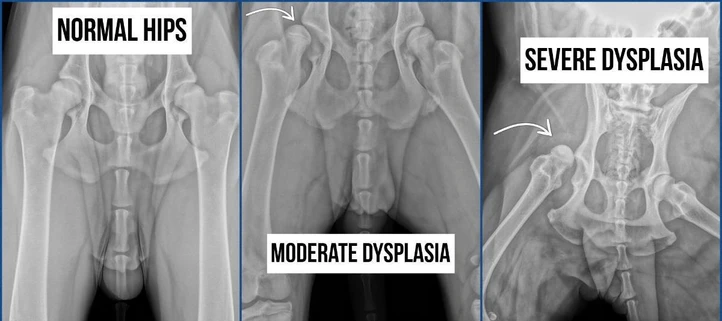

Dog hind leg weakness often becomes obvious through something the German Shepherd stops doing before the owner notices any major physical change.
The dog still eats normally.
Body weight may barely move.
The coat still looks full.
But the jump into the car suddenly needs more effort.
Getting up after a long nap looks different.
The thighs are not quite as full as they were last year.
A normal walk ends sooner.
And sometimes the rear of the dog seems less stable during a turn.
For an older German Shepherd, these changes can involve muscle loss—but muscle loss is only one possible part of the story.
Aging, arthritis, reduced activity, spinal or neurological disease, digestive illness, injury, and other health problems can all change rear-leg strength.
That is why the useful question is not simply:
“Is my dog losing muscle because he is old?”
A better question is:
What pattern of weakness is developing, and what else changed with it?
Start With the Change, Not the Diagnosis
Before trying to decide what is causing dog hind leg weakness, think back six months.
Which statement sounds most like your German Shepherd?
A. Both back legs gradually look thinner, but the dog is otherwise comfortable.
B. One thigh is clearly smaller than the other.
C. The dog looks strong enough but has trouble placing the rear paws normally.
D. The dog is stiff, slow to rise, and reluctant to climb.
E. The dog is losing body weight and rear-leg muscle despite eating normally or even eating more.
These five patterns can point veterinary investigation in very different directions.
They should not all be treated as ordinary aging.
Pattern A: Both Hind Legs Are Slowly Losing Muscle
This is the pattern many owners associate with senior age.
The thighs gradually lose fullness.
The change is relatively symmetrical.
Movement becomes a little slower.
The dog may sleep more and exercise less than it did several years earlier.
Age-related loss of skeletal muscle is often described as sarcopenia in dogs.
Muscle mass and strength can decline as dogs age, particularly when activity decreases.
But age-related does not mean meaningless.
Muscle helps a German Shepherd:
Stand from the floor.
Stabilize the hips and knees.
Walk without swaying.
Climb.
Turn.
Maintain balance.
Recover from a slip.
Continue participating in normal family life.
Even gradual senior dog muscle loss can therefore affect quality of life if enough strength disappears.
Pattern B: One Hind Leg Is Smaller Than the Other
Now the picture changes.
If one thigh is clearly smaller, do not immediately call it normal aging.
Muscle usually shrinks when it is not being used normally.
Imagine that the left hip or knee hurts.
The German Shepherd begins transferring more weight to the right side.
The dog may still walk.
It may not cry.
It may not even limp dramatically.
But every day, the painful side does slightly less work.
Over time, the difference becomes visible.
One thigh becomes flatter.
The other stays stronger.
One-sided hind leg muscle loss in dogs can occur with orthopedic pain, previous injury, joint disease, nerve problems, or other conditions affecting how the limb is used.
The smaller muscle may therefore be a clue rather than the original problem.
Pattern C: The Legs Look Fairly Normal, but the Feet Are Acting Strange
This is where dog hind leg weakness can stop being mainly a muscle question.
Pay attention to paw placement.
Does your German Shepherd occasionally drag the top of a rear paw?
Do the back toenails scrape against the ground?
Does a paw fold under for a moment?
Does the rear of the dog cross or sway?
Does the dog seem less aware of exactly where the back feet are?
Those changes can suggest neurological involvement rather than simple age-related loss of muscle.
German Shepherds are among the breeds in which degenerative myelopathy can occur. It typically affects older dogs and can produce progressive, often initially nonpainful, hind-limb weakness and loss of coordination. Other spinal and nerve disorders can create similar signs, so paw dragging should not be diagnosed from appearance alone.
If rear-foot placement begins changing, veterinary evaluation becomes much more important than simply trying to strengthen the legs at home.
Pattern D: The Dog Is Stiff Before It Is Weak
Some German Shepherds appear to lose strength because movement has become painful.
The dog rises slowly.
Stairs are avoided.
Jumping disappears.
Walks become shorter.
The dog rests more.
Then the thighs begin getting smaller.
In this situation, the muscle change can be secondary.
The underlying issue may be joint pain.
Osteoarthritis can cause pain, reduced joint movement, lameness, and muscle wasting.
That creates a cycle:
Pain → less movement → less muscle use → muscle loss → movement becomes harder
Arthritis can contribute to dog hind leg weakness when joint pain causes a senior German Shepherd to move less over time, gradually leading to reduced mobility and muscle loss.
The arthritis article is already published on RTK9.
Pattern E: The Dog Is Losing Muscle and Overall Body Weight
This is different again.
A German Shepherd that becomes thinner everywhere may be losing both fat and muscle.
Now ask another question:
What happened to appetite?
If appetite has fallen, many illnesses can contribute to weight and muscle loss.
But if the dog is eating extremely well—or seems constantly hungry—while continuing to get thinner, that pattern deserves special attention.
German Shepherds have an important breed association with exocrine pancreatic insufficiency, or EPI.
With EPI, food enters the body but digestion and nutrient absorption are impaired.
The result can include weight loss despite strong appetite, abnormal stools, and loss of body condition.
When muscle loss appears alongside a strong appetite, ongoing weight loss, and abnormal stools, EPI in dogs may be one of the conditions a veterinarian considers.
The dedicated EPI page is already live on RTK9.
7 Changes That Matter More Than the Number on the Scale
The SEO title says seven, but instead of giving you seven repetitive symptom sections, use these seven observations as a monthly snapshot.
| What to Watch | What Changed? |
|---|---|
| 1. Thigh shape | Back legs becoming narrower |
| 2. Rising | Needs more effort to stand |
| 3. Walking distance | Tires sooner than before |
| 4. Turning | Rear becomes unstable or takes extra steps |
| 5. Paw placement | Toes scrape, drag, or fold |
| 6. Symmetry | One rear leg smaller than the other |
| 7. Recovery | Normal activity causes much more fatigue afterward |
A single change does not identify a diagnosis.
Several progressive changes create a pattern worth investigating.
A German Shepherd Can Lose Muscle Without Losing Weight
This is one of the easiest things to miss.
Suppose your dog weighed 88 pounds last year.
Today, the scale still says 88.
It seems reassuring.
But body weight does not tell you how much is:
Muscle.
Fat.
Water.
Bone.
A senior dog can lose lean muscle and gain body fat while the total number barely changes.
So an overweight German Shepherd can still have meaningful muscle loss.
This is why simply asking, “Has his weight changed?” is not enough.
You also need to ask:
Has his body composition changed?
Use Your Hands, Not Only Your Eyes
A German Shepherd’s coat can hide gradual changes.
Run your hands gently over four areas.
The Spine
Feel along both sides of the backbone.
Has it become more prominent?
The Shoulders
Do the shoulder blades feel sharper than they once did?
The Pelvis
Are the hip bones easier to identify?
The Thighs
Do both rear legs still feel full and similar?
Repeat the same check every few weeks.
Consistency matters more than trying to judge the dog from one inspection.
The Chair Test—Without Using a Chair
For people, strength assessments often use repeated sit-to-stand movements.
For a senior German Shepherd, do not repeatedly force the dog to sit and stand just to test strength.
Instead, watch one completely natural rise.
After the dog has been resting, observe how it gets up.
A strong movement tends to be smooth.
With dog hind leg weakness, you may notice:
The front end rises first.
The dog rocks forward.
The rear feet reposition several times.
The dog pulls heavily with the front legs.
The hindquarters come up slowly.
The feet slip outward.
Then watch the first five steps.
Do they become normal quickly?
Or does weakness remain?
A ten-second phone video every month can reveal changes that memory misses.
The Turn Tells You Something the Walk May Hide
Straight walking can hide weakness surprisingly well.
Turning requires controlled weight transfer.
Watch your German Shepherd make an ordinary turn to the left and then later to the right.
Do not repeatedly spin the dog for testing.
Just observe normal movement.
If one direction consistently requires more steps, causes crossing of the rear legs, or looks unstable, mention it during the veterinary examination.
Symmetry is useful information.
The Car Can Become an Early Warning System
German Shepherd owners often notice mobility changes around vehicles before they notice them anywhere else.
Getting into a car requires:
Rear-leg power.
Coordination.
Joint range of motion.
Balance.
Confidence.
A dog may approach the car enthusiastically, then pause.
The desire is still there.
The physical confidence is not.
That pause can appear before an obvious limp or severe dog hind leg weakness.
Using a stable ramp can remove an unnecessary high-impact movement without turning the dog into an inactive senior.
Do Not Confuse Weakness With Pain
They can look similar.
A painful dog may refuse a movement even though the muscles are capable of performing it.
A neurologically weak dog may want to perform the movement but physically struggle.
A dog with substantial muscle loss may simply lack the previous power.
And some senior German Shepherds have more than one problem at the same time.
This is why veterinary examination often includes watching gait, assessing joints and the spine, checking reflexes, evaluating paw placement, and looking at muscle condition. Neurologic evaluation of hind-limb weakness can help distinguish muscle, nerve, spinal cord, and orthopedic patterns.
Dog Hind Leg Weakness Is Not One Disease
This is probably the most important sentence in the article.
Dog hind leg weakness is a symptom pattern.
Possible contributors include:
Age-related muscle decline.
Arthritis.
Hip or knee disease.
Previous injury.
Reduced activity.
Lumbosacral disease.
Peripheral nerve disease.
Degenerative myelopathy.
Muscle disease.
Nutritional problems.
Systemic illness.
Cancer.
Other neurological conditions.
German Shepherds can also develop degenerative lumbosacral disease, which may cause difficulty using the hind legs, lower-back pain, weak reflexes, and muscle wasting.
That is why the treatment depends entirely on what is driving the weakness.
The Wrong Response: “He Needs More Exercise
Sometimes he does need more appropriate activity.
But more exercise is not automatically the answer.
Imagine a German Shepherd with painful arthritis.
Making the dog walk much farther may increase pain.
Now imagine a dog with neurological weakness.
The exercise plan may need to focus on safety and controlled rehabilitation.
Or imagine a dog losing muscle because of a digestive disease.
Walking longer does not fix nutrient absorption.
Before trying to “build the back legs,” understand why they became weak.
The Better Question: How Much Activity Can the Dog Recover From?
For an otherwise stable senior German Shepherd, movement remains important.
Muscles need to be used.
But appropriate senior exercise is not the same as exhausting the dog.
Instead of asking:
“How far can he walk?”
Ask:
“How well does he recover afterward?”
Watch the dog:
Two hours later.
That evening.
The following morning.
If a walk looks easy during the activity but the dog can barely rise the next day, the session may have been too demanding.
Consistency often matters more than intensity.
The Senior Strength Formula
Think about preserving strength through four separate areas.
Movement
Keep the dog moving at a level appropriate for its condition.
Comfort
Treat pain instead of expecting the dog to exercise through it.
Nutrition
Make sure the diet matches the dog’s health and body condition.
Environment
Give the dog enough traction and accessibility to actually use the strength it has.
If one of these is missing, maintaining muscle becomes harder.
Why Slippery Floors Matter
Imagine trying to stand while your feet slide in opposite directions.
That is what smooth flooring can feel like to a weak senior dog.
The German Shepherd begins compensating.
Steps become shorter.
Turning becomes cautious.
The dog avoids certain rooms.
Standing requires more effort.
Eventually, less movement takes place inside the house.
Strategically placed nonslip runners can make frequently used routes easier:
Bed to door.
Bed to water.
Living room to backyard.
Food area to resting area.
This does not rebuild muscle by itself.
It allows the dog to use existing strength more confidently.
Should You Feed More Protein?
Not automatically.
Protein provides amino acids needed to maintain body tissues, including muscle.
But an older German Shepherd’s nutrition should be based on the entire medical picture.
A healthy senior has different needs from a dog with kidney disease.
A dog with EPI has different concerns from an overweight arthritic dog.
A dog with chronic gastrointestinal disease may have another nutritional plan.
The objective is not simply “more protein.”
The objective is adequate appropriate nutrition for the individual dog.
When More Food Makes Mobility Worse
If your German Shepherd is losing muscle while gaining fat, simply increasing calories can create a problem.
More body fat means more weight for weakened hind limbs to carry.
The dog moves less.
Joint load increases.
Activity declines.
Muscle receives even less stimulation.
So if body shape is changing while weight remains stable, do not automatically increase food.
Determine whether you are looking at true weight loss or a body-composition change.
When Rehabilitation Makes Sense
Some senior dogs benefit from professional veterinary rehabilitation.
The goal may include maintaining remaining muscle, improving balance, encouraging safer movement, and preserving daily function.
But rehabilitation should match the cause.
A dog recovering from an orthopedic injury may need one type of program.
A dog with arthritis may need another.
A neurologically affected German Shepherd may need different goals.
The phrase “strengthening exercises” sounds simple.
The underlying condition determines whether those exercises are appropriate.
The 3-Photo System
Here is a much easier way to monitor physical change than staring at your dog every day.
Once every month, take only three photographs.
Photo 1: From above.
Photo 2: From the side.
Photo 3: Directly behind the dog while standing naturally.
Use approximately the same distance and lighting.
Do not pose the dog unnaturally.
After three to six months, compare them.
Look at:
Thigh width.
Waist.
Spine.
Pelvis.
Overall symmetry.
Photos can reveal gradual hind leg muscle loss in dogs much more clearly than memory.
The 20-Second Video System
Photographs show shape.
Video shows function.
Record:
Five seconds standing.
Five seconds walking away.
Five seconds walking toward you.
Five seconds walking from the side.
Save the date.
If dog hind leg weakness progresses, the difference between videos several months apart can be striking.
These clips may also help your veterinarian see how the dog moves at home rather than only inside an unfamiliar clinic.
When This Is More Than Normal Aging
Some changes deserve faster attention.
Do not simply monitor at home when your German Shepherd develops:
Sudden severe hind-leg weakness
Inability to stand
Dragging one or both hind legs
Knuckling that is becoming frequent
Major one-sided muscle loss
Significant pain
Collapse
Rapid unexplained weight loss
Loss of bladder or bowel control
Severe coordination changes
Rapid decline over days or weeks
Sudden paralysis or severe weakness can involve the spinal cord or peripheral nerves and is very different from gradual senior muscle decline.
The Bigger German Shepherd Health Picture
Rear-leg weakness does not happen in isolation from the rest of the body.
Older German Shepherds may simultaneously develop orthopedic, neurological, digestive, sensory, or age-related health problems.
Rear-leg weakness can overlap with several German Shepherd health problems, especially orthopedic, neurological, and age-related conditions.
That article is already live on RTK9.
The Goal Is Independence, Not Youth
A senior German Shepherd does not need the hindquarter muscle of a three-year-old working dog to have a good quality of life.
The useful questions are simpler.
Can the dog stand independently?
Can it walk comfortably?
Can it reach water?
Can it go outside?
Can it maintain balance?
Can it still enjoy normal interaction?
Can it participate in appropriate activity?
Those abilities matter far more than maintaining a young dog’s physique.
Maintaining strength, healthy body condition, and comfortable movement becomes increasingly important throughout the later stages of the German Shepherd lifespan.
That page is also already part of RTK9.
Frequently Asked Questions About Dog Hind Leg Weakness
What Causes Dog Hind Leg Weakness in Older Dogs?
Possible causes include age-related muscle loss, arthritis, orthopedic disease, spinal problems, nerve disease, degenerative myelopathy, reduced activity, injury, and other medical conditions.
The pattern of weakness helps guide the diagnostic process.
Is It Normal for an Old German Shepherd’s Back Legs to Get Weak?
Some reduction in muscle and strength can occur with aging.
However, progressive weakness should not automatically be dismissed as normal, especially when it is rapid, asymmetrical, painful, or accompanied by neurological changes.
Why Are My German Shepherd’s Back Legs Getting Skinny?
Loss of thigh muscle can result from aging, reduced activity, pain, joint disease, nerve dysfunction, nutritional problems, or other medical conditions.
One-sided loss is especially important to investigate.
Why Is My Dog Weak in the Back Legs but Not in Pain?
Some neurological conditions can initially cause nonpainful hind-limb weakness.
Degenerative myelopathy is one example seen in German Shepherds, although other diseases can produce similar signs.
What Does Knuckling Mean in Dogs?
Knuckling occurs when a dog places the top of the paw against the ground instead of immediately correcting it to the normal position.
Repeated knuckling can indicate a neurological problem and deserves veterinary evaluation.
Can Arthritis Cause Weak Back Legs?
Yes.
Pain can reduce how normally a dog uses its hind limbs.
Over time, reduced activity and disuse can contribute to muscle loss and decreased strength.
Can My Dog Have Muscle Loss Without Losing Weight?
Yes.
A dog can lose lean muscle while maintaining or gaining body fat, leaving total body weight almost unchanged.
Can Walking Strengthen an Older Dog’s Hind Legs?
Appropriate regular movement can help maintain muscle use and mobility.
The amount and type of exercise should match the underlying health condition and the dog’s ability to recover comfortably.
Should I Feed More if My German Shepherd Is Losing Muscle?
Not automatically.
The cause of muscle loss, total body condition, current diet, activity, and medical health should be considered before increasing calories.
Why Is Only One Back Leg Smaller?
Significant asymmetry can result when one limb is being used less because of pain, injury, joint disease, or nerve dysfunction.
A veterinary examination can help identify the cause.
Can Degenerative Myelopathy Cause Hind Leg Weakness?
Yes.
Degenerative myelopathy can cause progressive weakness and loss of coordination in the hind limbs of older dogs, including German Shepherds.
When Is Dog Hind Leg Weakness an Emergency?
Sudden inability to stand, paralysis, severe pain, collapse, major trauma, or rapidly worsening neurological signs require prompt veterinary attention.
Final Thoughts on Dog Hind Leg Weakness
Dog hind leg weakness is not one disease and should not be treated like one.
For one senior German Shepherd, the first clue may be gradual muscle loss.
For another, it may be arthritis.
For another, one leg becomes smaller because it is painful.
Another dog may begin dragging paws because the problem is neurological.
And a German Shepherd losing weight despite a strong appetite may have a completely different medical problem affecting nutrition.
The pattern matters.
Look at the thighs.
Compare both sides.
Watch the first steps after rest.
Notice paw placement.
Observe turns.
Track walking distance.
Pay attention to body weight—but do not rely on the scale alone.
The goal is not to stop aging.
It is to recognize when ordinary aging ends and a treatable or manageable health problem may begin.
Preserving strength allows a senior German Shepherd to keep doing the things that matter most:
Standing.
Walking.
Exploring.
Going outside.
Following the family.
And remaining as independent as possible.
VCA also discusses age-related loss of muscle mass and strength in its guide to helping senior dogs age gracefully.